 by
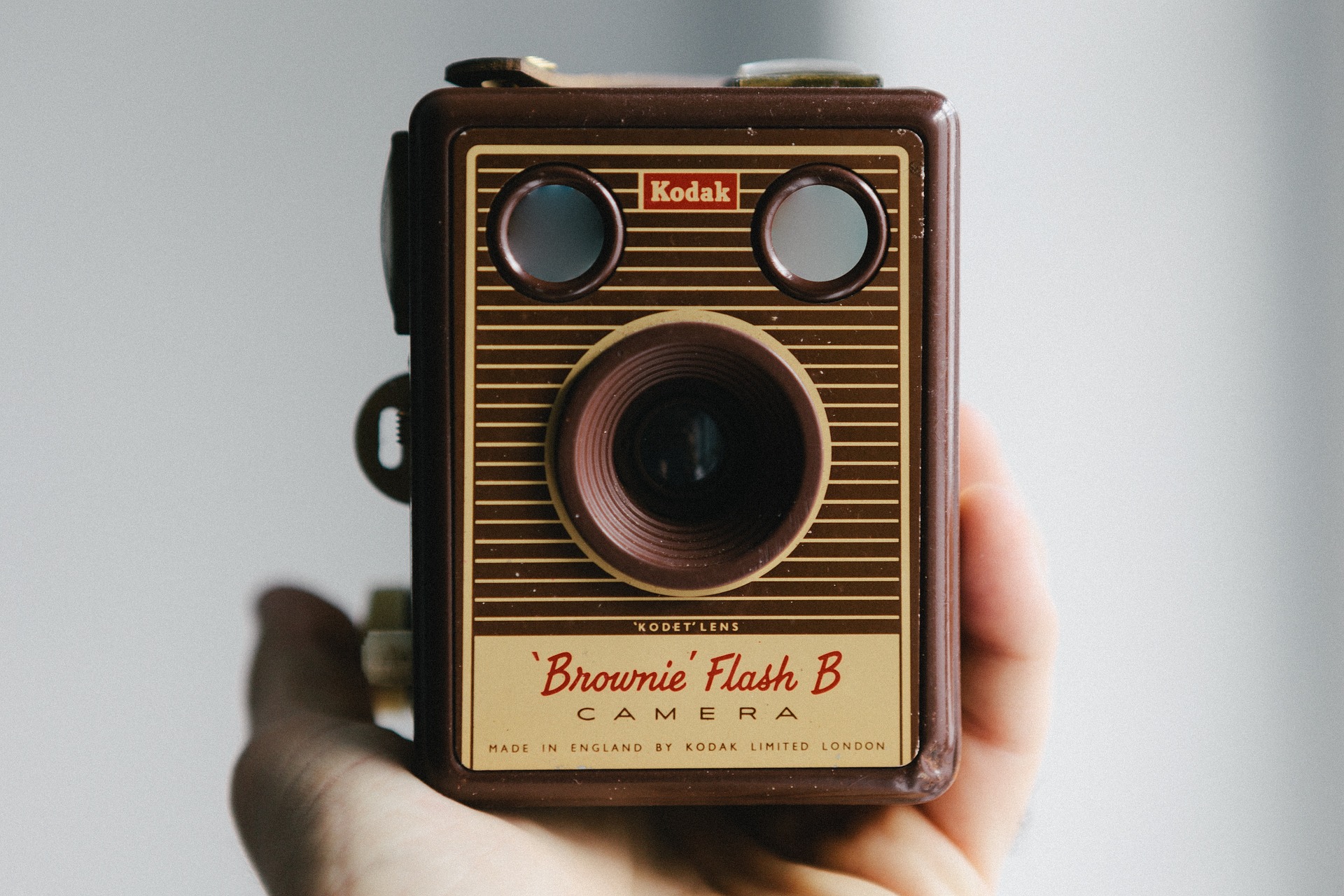
by In 1975, a 24-year-old engineer named Steve Sasson built the world’s first digital camera inside a Kodak lab. He’d been given a throwaway assignment in a hallway conversation that lasted maybe 60 seconds. The task: figure out if a charge-coupled device has any practical use.
With no one watching, Sasson set out to build the device, and he built it entirely from scavenged parts. A lens from a junk bin, 16 batteries, and a cassette tape for memory. It weighed a whopping 8 pounds and took a swift 23 seconds to save a single image.
When he presented it to Kodak’s executives in 1976, their response was immediate: “Why would anyone want to take a picture this way when there’s nothing wrong with conventional photography?”
Kodak did what any rational institution would do. They filed for a patent and then they told Sasson not to talk about it.
They did this for a surprisingly simple reason, acknowledging the technology would signal to consumers that film was dying. And film was Kodak’s entire business. Their biggest revenue drivers were cameras, paper, processing labs, and chemicals. Digital photography wouldn’t be contributing to any of those.
Sasson later explained it plainly: “They didn’t want to give the impression that Kodak was abandoning film… They also felt that people looked to Kodak to be the authority on how to take pictures. So they didn’t want to ever suggest that a technology to take pictures would be necessary or even acceptable.”
In 1989, Sasson built the first DSLR. Kodak, naturally, declined to sell it.
By the late 1990s, Japanese competitors released what Kodak had been sitting on for 25 years. By 2009, Sasson had already retired. By 2012, Kodak had filed for bankruptcy. The camera Sasson built in 1975? It now sits in the Smithsonian.
Here’s what makes this story interesting. Kodak wasn’t blind, they weren’t arrogant. They were scared and they were trapped. Their size, their brand, and their entire revenue model required them to stay silent about what they knew was coming.
That same dynamic is playing out in healthcare right now. If you’re a surgeon employed by a hospital system, you’re closer to the Sasson side of this story than you might think.
TL;DR: AI recommendations are beginning to rival traditional referrals in how patients discover providers.1 But individual hospitals appear in under 5% of AI health responses.2 The institution is structurally unable to produce the clear, attributed content AI rewards. The individual surgeon can.
What Does AI Search Actually Reward?
230 million people ask ChatGPT health questions every week.3 Patients are increasingly using AI tools like ChatGPT and Google AI Overviews to research and compare providers, and early data suggests AI recommendations are beginning to rival traditional physician referrals as a factor in how patients choose who to see.1
These systems all reward the same three things: clarity, specificity, and attribution.
It’s looking for: who said this, what exactly do they mean, and why should I trust them.
This isn’t necessarily new, search has always rewarded this (or tried to). AI is finally making it non-negotiable.
89% of healthcare queries now trigger AI Overviews.4 For orthopedics specifically, that number is 94%.
But those numbers don’t apply equally. For the query type that matters most to surgeons — ‘find a doctor near me’ — Google didn’t expand AI Overviews, they removed them entirely.
Why did Google remove AI Overviews from provider queries?
In 2023 100% of Google searches includes AI Overviews for Google “near me” provider queries. By December 2025, they had removed them entirely.4
The most cited reason is that AI Overviews were generating inaccurate health advice. A Guardian investigation in January 2026 found AI Overviews delivering dangerous recommendations across cancer, mental health, and screening queries, and Google pulled overviews from certain medical searches shortly after.5 6
When it comes to provider queries, I think there is a simple explanation for the lack of viable information. There just isn’t enough published, attributed content from individual providers for AI to draw from. When a patient searches “orthopedic surgeon near me” and the only material available is hospital directory listings and generic bios, AI doesn’t have anything real to synthesize. So it fills in the blanks. And when it fills in blanks about healthcare providers, people get hurt.
That means the research phase, where patients form opinions about conditions and treatments, is now dominated by AI. But the “find a doctor near me” phase is still traditional search, maps, directories.
Patients form their opinions during research. Then they go find a surgeon locally. If you weren’t part of the research phase, you weren’t in the consideration set. This is particularly acute for mid-career surgeons who have been invisible for years while younger colleagues built a publishing presence.
Why Can’t Hospitals Produce What AI Rewards?
Individual hospitals appear in under 5% of AI health responses, while the top 10 organizations capture 52.8% of all AI health citations.2 NIH alone accounts for roughly 39%. Then Healthline, Mayo Clinic, Cleveland Clinic.
The reason for this is strictly structural. Large institutions write content that is legal-reviewed, committee-approved, and deliberately vague. When you have 47 service lines, 200 physicians, and a brand that took three decades to build, you don’t let any one person say anything too specific. Too much liability and definitely too much competitive tension between surgeons on the same staff.
The result is content that reads like it was written by a committee… because it was.
Because of this AI can’t figure out what to do with it.
This is a positive thing for surgeons.
A hospital website with 4,000 pages about 200 conditions sends conflicting signals. AI can’t parse what they do. The institution spent the marketing budget, and the algorithm still doesn’t know who to recommend. Meanwhile, the surgeon’s hospital bio isn’t doing the work they think it is.
This is a completely rational decision. A hospital will not name an individual surgeon as the definitive answer to a specific clinical question. That would create a liability across the whole system. There would be competitive tension with surgeons on the same staff and a portability problem if a surgeon builds an audience and then leaves.
This is the same logic that kept Kodak silent about the digital camera for 25 years. Protecting the brand they spent decades building, is both rational and understandable.
At the same time, it is completely unhelpful for individual surgeons.
| Kodak | Hospital System | |
|---|---|---|
| Had the answer | Digital camera (1975) | The surgeon’s expertise |
| Couldn’t release it | Would threaten film revenue | Would threaten institutional brand control |
| Told the inventor to stay quiet | Instructed Sasson not to speak | Culture discourages it even when the contract doesn’t prohibit it |
| The asset sat unused | 25 years | As long as the surgeon stays quiet |
| Competitors filled the gap | Japanese camera makers | The surgeon who publishes |
Why Do Individual Surgeons Have the Advantage?
Pages ranked 6th through 10th with strong authority signals get cited 2.3x more by AI than top-ranked pages with weak authority.7 And 76.4% of ChatGPT’s most-cited pages were recently updated. You don’t need to outrank Mayo Clinic. You just need AI to understand who you are.
AI doesn’t recommend brands. It recommends entities it can understand.
An “entity” in this context is a person or thing the system can clearly identify, categorize, and attribute expertise to. A surgeon who publishes consistently on a specific clinical topic becomes a clean entity. AI knows who they are, what they do, and what they think about it.
That’s all it needs.
A surgeon posting weekly has a structural advantage over a hospital page last updated in 2022.
Think about what happens when someone asks ChatGPT, “Should I have lumbar fusion at 45 with two-level disease and an active lifestyle?” No hospital homepage answers that question. No committee-approved service line page gets that specific. But a surgeon who has written about exactly that patient… AI can find that and AI can cite that. The institution may own the category. But the surgeon can own the question.
There’s one more layer worth mentioning. Fujifilm faced the exact same structural problem as Kodak. Same era, same industry, same existential threat. However, they survived because they asked a different question. Instead of “what do we sell,” they asked “what are we actually good at.” They took their film chemistry expertise and transferred it into cosmetics, pharmaceuticals, and medical imaging.
The surgeon equivalent is the same question. The ones who ask what they’re actually an expert in, beyond the procedure itself, are the ones who can build something that compounds over time.
What Does Showing Up Actually Look Like?

63% of U.S. online health searchers already find AI-generated health information reliable.8 But 90% still trust physicians most. Read that again.
The surgeons getting found by AI right now aren’t doing anything dramatic.
They’re publishing in plain language, consistently, on specific clinical topics and patient concerns they have real opinions about. They’re not trying to be influencers. They’re explaining what they already explain to patients every day… just making it findable.
Their name appears as the author. Their credentials are clear. Their perspective is specific enough that AI can parse it and attribute it to a real person with real expertise. This is what building a thought leadership presence actually looks like in practice.
The barrier here isn’t time or budget. It’s the willingness to say something specific, publicly, with your name on it. And for surgeons who feel like they can’t do the writing themselves, that problem has been solved for a while now.
The real question is whether you’re willing to occupy the territory your institution can’t enter.
What Can Kodak Teach a Surgeon?
Sasson knew in 1975 what the world would look like in 2000. He was right about all of it. He just worked inside a structure that couldn’t move.
While it may feel that way at times, the surgeon isn’t inside that structure the same way. You have a name. You have a voice. You have cases, systems, decisions, and a point of view that no institution can replicate or suppress… unless you decide to stay quiet.
Kodak couldn’t speak because speaking would undermine everything they’d built. The hospital system faces a version of the same constraint. They can’t name you as the answer to a specific clinical question because that creates problems they aren’t built to manage.
That constraint is your opening.
The surgeons getting found by AI right now aren’t the ones with the biggest marketing budgets or the most institutional support. They’re the ones willing to say something specific and put their name on it.
Footnotes
-
rater8, The Next Evolution of Patient Choice (Aug 2025). Survey of 1,000+ patients on how AI tools influence provider selection. ↩ ↩2
-
upGrowth, Provider vs Aggregator: Who AI Cites for Healthcare (2026). Analysis of 615 ChatGPT health citations. ↩ ↩2
-
OpenAI, via TechCrunch (Jan 2026). Self-reported figure at ChatGPT Health launch. ↩
-
BrightEdge, Healthcare and AI Overviews: How Google Sharpened Its Approach Over Three Years (Dec 2025). Tracked AI Overview trigger rates across healthcare query categories from 2023-2025. ↩ ↩2
-
The Guardian investigation (Jan 2026), via Search Engine Journal. Found AI Overviews delivering dangerous recommendations across cancer, mental health, and screening queries. ↩
-
TechCrunch (Jan 2026). Google removed AI Overviews from certain medical queries following accuracy concerns. ↩
-
upGrowth, How AI Recommends Doctors and Hospitals (2026). Aggregated data from WebFX, Surfer, and Outcomes Rocket on AI citation patterns. ↩
-
Annenberg Public Policy Center, Many in U.S. Consider AI-Generated Health Information Useful and Reliable (Apr 2025). SSRS survey, n=1,653. ↩